
UPDATE — FINAL JUDGMENT ENTERED
On September 18, 2026, Judge Beatrice Butchko Sanchez entered the Final Judgment following the August 24–26 trial.
The Court found that Councilmembers Kassandra Timothe, Mary Estimé-Irvin and Pierre Frantz Charles violated Section 19 of the North Miami Charter by using intermediaries to threaten City Manager Rasha Cameau with termination if she disciplined or terminated Public Works Director Wisler Pierre-Louis.
The Court found insufficient evidence that the three councilmembers privately colluded to terminate Cameau in violation of Florida’s Sunshine Law.
Read the Final Judgment and case update.
Case ruling update: On August 27, 2026, the court found that Timothe, Estimé-Irvin and Charles violated Section 19 of the North Miami Charter. The court found that the Sunshine Law claim was not proven. Post-trial proceedings remain pending.
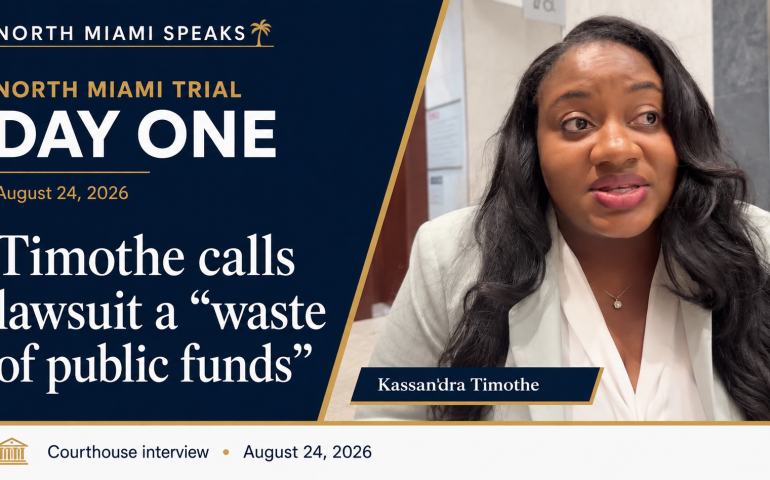
Kassandra Timothe speaks outside court on the first day of North Miami’s Sunshine and Charter trial, August 24, 2026.
North Miami resident Eileen Bicaba’s lawsuit against Council members Kassandra Timothe, Mary Estimé-Irvin and Pierre Frantz Charles began before Judge Beatrice Butchko Sanchez.
Outside the courtroom, Timothe struck a dismissive tone, telling CBS News Miami:
“This is just an injunction case, and it’s sad to say, but it’s a waste of public funds right now.”
Kassandra Timothe speaks outside court on the first day of North Miami’s Sunshine and Charter trial, August 24, 2026. Video excerpt: CBS News Miami.
Inside the courtroom, the proceedings addressed allegations that the council members interfered with former City Manager Rasha Cameau’s management of City employees and coordinated public business outside public meetings.
Defense tries to exclude the Charter violation; judge denies motion
Before testimony began, defense attorneys sought to limit the case, arguing that the corrected complaint did not seek relief for a City Charter violation.
Bicaba’s attorney, David Reiner, pointed to paragraph 45 of the June 12, 2024 corrected complaint. That paragraph expressly alleges a Section 19 violation and incorporates the detailed allegations in paragraphs 10–26 concerning councilmembers’ and intermediaries’ involvement in personnel matters.
The alleged Section 19 violation had been stated in the complaint more than two years before trial.
Reiner told the court:
“And it talks about a violation of the Sunshine law and a violation of charter. Those are the two things we’re going to be discussing here at trial.”
After hearing both sides, Judge Butchko Sanchez ruled: “All right. Motion denied.”
Testimony proceeded.
Defense challenges documents and telephone-record compilation
The defense also sought to exclude documents it claimed had not been disclosed during discovery. Reiner opposed a blanket exclusion and argued that objections should be addressed as individual documents were offered. The judge declined to rule on 62 documents as a group without knowing how each would be used:
“I can’t rule on 62 documents without knowing the context.”
She directed the defense to raise objections as documents were offered and deferred ruling on the motion. The defense separately challenged Bicaba’s compilation of telephone records. The judge required an evidentiary foundation before it could be used and deferred a final ruling:
“Let’s see what comes into evidence.”
These were deferred decisions—not a blanket ruling excluding all of Bicaba’s documents.
Bicaba takes the stand
Bicaba testified about her investigation, public-records requests and the events surrounding Cameau’s removal. She described her efforts to track the delayed NE 3rd Court drainage project and question the information residents received about its schedule and funding. The court admitted the March 30, 2024 Public Works Performance Issues memorandum, which documented serious concerns about the department under Director Wisler Pierre-Louis.
Bicaba’s testimony then took the court through the three council meetings central to the lawsuit: April 9, May 7 and June 4, 2024.
Residents heard rumors that Cameau would be fired but the Public was told that Cameau’s removal was not happening
Bicaba testified that community members had begun hearing rumors that the council intended to remove Cameau at the April 9 meeting. She called Mayor Alix Desulme to determine whether the rumors were true. According to Bicaba, Desulme said Cameau’s removal would not be considered and discouraged her from attending. During the meeting, Desulme similarly stated that he had discouraged residents who called him from attending because Cameau’s removal was not on the agenda. Bicaba, a longtime community advocate, was not feeling well that day. Nevertheless, she attended because she knew council members could request that emergency matters be added to the agenda at the beginning of a regular meeting. She intended to speak only if Cameau’s removal was going to be considered.
Estime-Irvin add-on $100,000 festival request demonstrates the four-vote requirement – and then bypasses it
At the beginning of the April 9 North Miami Council meeting, Estimé-Irvin sought to add a proposed $100,000 festival to the agenda. The council was advised by the City attorney, Jeff Cazeau, that adding an item required a supermajority—four affirmative votes.
That requirement appears in North Miami Ordinance 1160:
“Any item(s) proposed for addition to an agenda for a regular meeting…shall be of an emergency nature only, and must receive four affirmative votes.”
Estimé-Irvin ultimately withdrew the festival request. The exchange demonstrated the established procedure. An item not appearing on the published agenda could be added only if it was an emergency and four councilmembers voted to add it.
April 9, 2024: The council discusses the four-vote requirement for adding an emergency item to the agenda. Estimé-Irvin subsequently withdrew her $100,000 festival request. Source: City of North Miami Council Meeting.
Timothe did not request that Cameau’s removal be added. Once it became clear that no removal item would be placed on the agenda, Bicaba left and continued listening from home because she was not feeling well.
Timothe waits until Council Reports to make the motion
The council completed its published business and eventually reached Council Reports, a portion of the meeting generally used for announcements and updates from councilmembers. Only then did Timothe move to fire Cameau immediately. Cameau’s removal had not been advertised, added to the agenda or announced to the public. Timothe did not seek the required four-vote supermajority.
The political reality was apparent: Timothe, Estimé-Irvin and Charles had three votes. Desulme and Councilman Scott Galvin opposed Cameau’s removal. Timothe therefore lacked the fourth vote required to place it on the agenda. The council had demonstrated the proper add-on procedure earlier that same evening when Estimé-Irvin raised the proposed $100,000 festival. Yet Timothe bypassed that procedure when introducing the far more consequential matter of removing the city manager.
Before Public Comments Mayor Alix Desulme discusses calls received before the April 9 meeting concerning rumors that City Manager Rasha Cameau would be removed. The matter was not listed on the published agenda. City of North Miami Council Meeting, April 9, 2024.
Residents were denied advance notice and a meaningful opportunity to be heard
The Miami-Dade Citizens’ Bill of Rights provides that persons entitled to notice of a municipal hearing must be timely informed of its:
“time, place and nature”
It also requires proposed resolutions to be available to the public at a reasonable time before a hearing, except in an emergency. Residents who relied on the published agenda—or on Desulme’s assurance that the rumor was untrue—had no reason to attend or remain at the meeting. By waiting until the published business was completed and then making the motion during Council Reports, Timothe acted after residents such as Bicaba had concluded that Cameau’s removal would not be considered. The City attorney later explained that the Public Forum had to be reopened before the council could act. But reopening the forum after the unadvertised motion was introduced could not provide advance notice to residents who were absent or had already left.
After Public Forum, Mayor Alix Desulme discusses discouraging residents from attending because Cameau’s removal was not on the published agenda. City of North Miami Council Meeting, April 9, 2024.
The public was told it was not happening. It was not advertised or added to the agenda. The motion came only after the published business was completed and residents had been given every reason to believe no such vote would occur.
Timothe presses to fire Cameau immediately
The April 9, 2024 meeting video showed Timothe pressing City Attorney Jeff Cazeau about whether the council could immediately fire Cameau under her employment contract. Cazeau advised that the council had to follow the removal procedure established by Section 18 of the Charter.
Kassandra Timothe presses to remove City Manager Rasha Cameau immediately, while City Attorney Jeff Cazeau explains that the council must follow the Charter’s removal process. City of North Miami Council Meeting, April 9, 2024.
Section 18 required the council to begin with a preliminary resolution stating the reasons for removal. That resolution had to precede the effective removal by at least 30 days. The manager could respond in writing and request a public hearing. After the hearing and “after full consideration,” the council could adopt a final resolution. May 14 was identified during the April 9 meeting as the date when the preliminary resolution would be considered.
Charles focuses on Cameau’s treatment of City employees
Charles, who had been appointed to the vacant District 4 seat rather than elected by District 4 voters, spoke directly about what he expected Cameau to do with City employees:
“The culture of the City of North Miami—and if you go back and look at my closing remarks when we hired the city manager—my only ask was, where we need to retrain, we retrain. Let’s retrain. Where we need to move people around, let’s move people around. But people don’t know what is going to happen tomorrow or Friday, that you will be sitting with everybody else. And then, you know, basically what we turned this City into is just a place of work with all new people, where we don’t have any staff that have been here for so long, and just basically for one reason—or I don’t exactly know the reason. So, basically, we need to foster a culture where we can work with people we don’t like.”
Charles did not name Pierre-Louis. But his remarks centered on Cameau’s personnel decisions: whether employees should be retrained, reassigned or removed, and whether longtime employees were being displaced. Wisler Pierre-Louis had submitted his resignation on April 5, only four days earlier. Bicaba testified that Charles’s remarks took on new meaning after she obtained public records concerning the conflict over Pierre-Louis. She believed he was referring to the Pierre-Louis situation and other employees. After watching Charles’s remarks, the judge permitted Bicaba to explain that understanding over a defense objection.
Cameau’s later memorandum, “Events That Led to My Termination,” supplied further context. It described pressure surrounding her effort to address Pierre-Louis’s performance and warnings that council members had the votes to remove her if she did not back away. Charles’s statement provided another link between the vote to remove Cameau and her exercise of personnel authority—precisely the area Section 19 placed under the city manager’s control.
More than nine hours of calls among the defendants and intermediaries
Bicaba also testified about telephone records documenting more than nine hours of calls between the defendant council members as well as intermediaries during the period surrounding the pressure involving Pierre-Louis and Cameau’s removal. The phone logs included an approximately two-hour conversation between Timothe and Estimé-Irvin around the time Pierre-Louis submitted his resignation.
The records did not disclose what the council members said. However, their timing, duration and pattern were offered as circumstantial evidence relevant to whether public business had been discussed outside publicly noticed meetings. That evidence became particularly significant when compared with the absence of substantive public discussion during the meetings at which the council acted.
May 7: The removal process is accelerated
At approximately 5 p.m. on Friday, May 3, the public received notice that Cameau’s preliminary removal resolution would be considered at a special meeting on Tuesday, May 7, at 5:30 p.m.—instead of at the May 14 meeting identified on April 9.
North Miami Ordinance 1160 provides that agendas for special meetings must be distributed at least 24 hours in advance and that no items may later be added to a special-meeting agenda.
But the larger question raised by the sequence was: What was the emergency?
The council members never publicly identified an emergency requiring the matter to be accelerated by one week. The May 7 special meeting followed Timothe’s unsuccessful effort to fire Cameau immediately on April 9. It advanced the same objective while giving the public only a few days’ notice.
The reasons offered were broad—and one conflicted with Section 19
The May 7 preliminary resolution listed the following reasons for Cameau’s removal:
- “Lack of confidence in the City Manager”
- A “lack of acceptable oversight and effective leadership”
- Failure to support and implement councilmembers’ “vision and goals”
- Failure to communicate properly
- Failure to follow councilmembers’ “direction and instruction”
It cited vague and broadly worded reasons without identifying the specific conduct underlying those accusations
Kevin Burns warns the council
During Bicaba’s testimony, the court was shown the May 7 Public Forum remarks of former North Miami Mayor Kevin Burns. Burns expressed the community’s concerns and explained the normal process expected when a city manager’s removal is being considered.
Former North Miami Mayor Kevin Burns addresses the council during Public Forum before the vote concerning City Manager Rasha Cameau. City of North Miami Special Council Meeting, May 7, 2024.
Councilman Galvin entered during the Public Forum and appeared not to know what was taking place. The preliminary resolution was not read into the record or explained to the public. A resident who had not already obtained and reviewed the meeting package would have had little information about the resolution’s contents or the action the council was preparing to take. Despite the importance of the decision and the concerns raised by Burns, the council members engaged in no substantive public discussion of the reasons for removing Cameau. The council adopted the preliminary resolution by a 3–1 vote, immediately suspended Cameau and appointed Anna Bo Emmanuel as interim city manager. Desulme was absent. Galvin voted no. Timothe, Estimé-Irvin and Charles voted yes.
Emmanuel had been offered the position before the public meeting
The council held no public discussion about who should replace Cameau or how that person should be selected. In her deposition—not during the trial—Anna Bo Emmanuel testified that she had been offered the interim city manager position before the May 7 meeting. At the meeting, Estimé-Irvin read a prepared statement announcing Emmanuel’s selection, and the council voted without publicly considering candidates or explaining how the selection had been made. The meeting therefore showed the public announcement and formal approval—not the deliberations that led to Emmanuel’s selection.
Read Anna-Bo Emmanuel’s deposition testimony, pages 22–24 (PDF)
June 4: no discussion, no full consideration and removal two days early
The requested public hearing was held on June 4. Cameau was permitted to respond in writing and submitted a written defense. Regardless of whether she responded orally or in writing, Section 18 required the council to give the matter “full consideration” before adopting a final resolution.
At the beginning of the hearing, Estimé-Irvin indicated that the decision had already been made. That raised a fundamental question: How could the council give Cameau’s response full consideration if it had already decided to remove her?
At the beginning of Cameau’s June 4 hearing, Mary Estimé-Irvin indicates that the decision had already been made—before the council publicly considered Cameau’s written response or discussed the final resolution.
The councilmembers did not publicly review Cameau’s submission, address her defense or discuss the stated reasons for removing her. They adopted the final resolution without substantive deliberation.
The final resolution nevertheless declared that the council had acted “after the public hearing and full consideration.” The meeting video showed no council discussion supporting that recital.
The council also acted too soon. Section 18 required the preliminary resolution to precede the effective removal by at least 30 days. The preliminary resolution was adopted on May 7, and the final resolution was adopted on June 4—only 28 days later. The final resolution made Cameau’s removal effective immediately upon adoption.
The hearing itself occurred within the separate 20-to-30-day period following Cameau’s request. But her removal became effective two days before the Charter’s mandatory 30-day minimum period had expired.
Did the later meetings cure what happened on April 9?
Florida law recognizes that some Sunshine Law violations may be cured through later independent action taken in the Sunshine. However, a properly noticed meeting and another vote do not automatically provide a cure. Florida courts distinguish genuine reconsideration from the “perfunctory ratification” of a decision already reached.
The Fourth District Court of Appeal has stated:
“Only a full, open hearing will cure a defect arising from a Sunshine Law violation.”
The absence of council discussion on both May 7 and June 4 was therefore significant. The council members did not publicly reconsider their decision, examine Cameau’s written response, explain their reasoning or engage in a meaningful debate about whether removing her served the City’s interests. The evidence raised a straightforward question:
If the council members did not discuss these decisions publicly, when and how were the decisions made?
Bicaba argued that the May 7 and June 4 meetings did not cure what occurred on April 9 because they did not provide the full, independent and open reconsideration required under Florida law.
The City had been warned that critical projects were at risk
Council meeting recordings presented during Bicaba’s testimony also addressed the condition of major City projects. Dr. Aneisha Daniel warned the council about the water plant, approximately $200 million connected to WIFIA financing, and other critical projects facing the City. The council therefore knew that it was considering a major administrative change during a particularly vulnerable period.
Dr. Aneisha Daniel warns the council about the water plant, WIFIA financing and other critical projects at risk. City of North Miami Council Meeting, April 9, 2024.
This should have been an opportunity for Timothe, Estimé-Irvin and Charles to pause and reconsider whether removing Cameau served the community’s best interests. Instead, the council proceeded without publicly discussing Daniel’s warnings or the consequences of changing leadership during a critical period.
More than two years later, councilmembers involved in Cameau’s removal are now downplaying the importance of the WIFIA financing—even though the financing and the projects dependent upon it were presented as critical when Cameau was removed.
North Miami would ultimately lose Daniel, Pierre-Louis and Cameau while the City faced major infrastructure and financing challenges.
Cameau describes the pressure surrounding Pierre-Louis
Cameau began her testimony later in the day. She described her efforts to meet with Wisler Pierre-Louis about his performance and contacts from Ringo Cayard and Larry Spring as concerns circulated about his possible termination. According to Cameau’s testimony, Cayard visited her home and conveyed concerns from elected officials.
She testified that he said they had the votes.
Asked what that meant to her, Cameau answered:
“That they have the vote to remove me.”
Her testimony supported the central Section 19 allegation: Cameau was attempting to address the performance of a department director under her authority while intermediaries warned her that councilmembers had the votes to remove her if she proceeded.
Her testimony was still underway when court adjourned. No ruling on the merits was issued that day.
Accountability is public business
Timothe’s characterization of the lawsuit as “just” an injunction case minimized what was at stake: whether residents can hold elected officials accountable for alleged violations of the rules governing their conduct.
The defendants’ legal defense is funded by the City. Bicaba has relied on personal funds and community support to bring the allegations before a judge.
Residents deserve to know whether councilmembers can introduce an unadvertised motion to remove the city manager during Council Reports, after the published business has been completed and without giving residents advance notice.
They deserve to know why the process was accelerated, why no emergency was publicly identified, why the council held no substantive discussion before voting and why the preliminary resolution only contained broad, non-specific reasons for ousting Cameau. They also deserve to know how decisions of this magnitude were made when the council members engaged in virtually no public discussion. Seeking answers to those questions is not a waste of public funds. It is a demand for public accountability.
Watch CBS4’s trial-opening coverage.
The Charter belongs to the people. Silence protects the powerful. Participation protects the people.
This retrospective account draws principally on the August 24 trial transcript, the City Council recordings presented during Bicaba’s testimony, the relevant resolutions and Timothe’s courthouse interview. The transcript was filed September 3, 2026, and added to this report September 4, 2026.