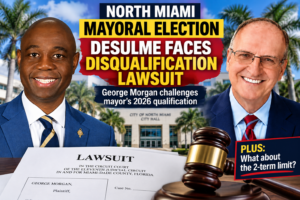

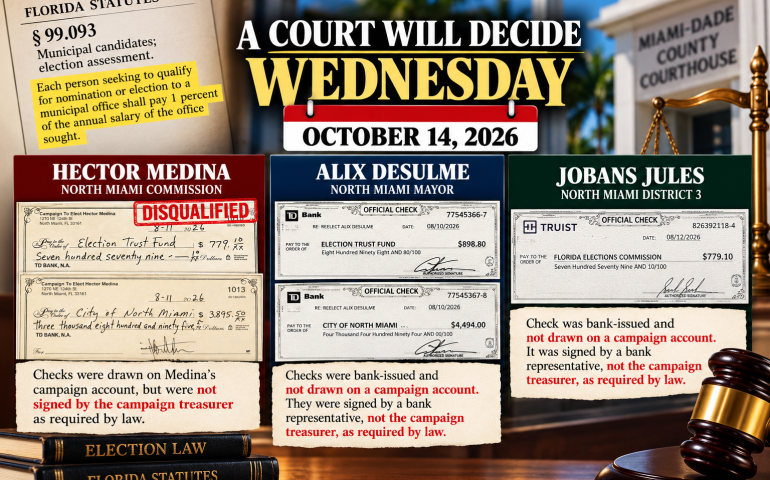
North Miami Mayor Alix Desulme’s qualification for the November 3 election goes before Judge Beatrice Butchko Sanchez on Wednesday, October 14, at 2:30 p.m.
Mayoral candidate George E. Duell Morgan is asking the court to disqualify Desulme, arguing that two TD Bank Official Checks submitted during qualifying did not comply with Florida’s election requirements.
The issue comes down to something fairly simple: What did the law require, and what did the candidate submit?
⚖️ Court Hearing — Wednesday, October 14
Time: 2:30 p.m.
Judge: Hon. Beatrice Butchko Sanchez
Courtroom: 24D
Location: Osvaldo N. Soto Miami-Dade Justice Center
20 NW 1st Avenue, Miami, FL 33128
Two Checks, Two Different Payments
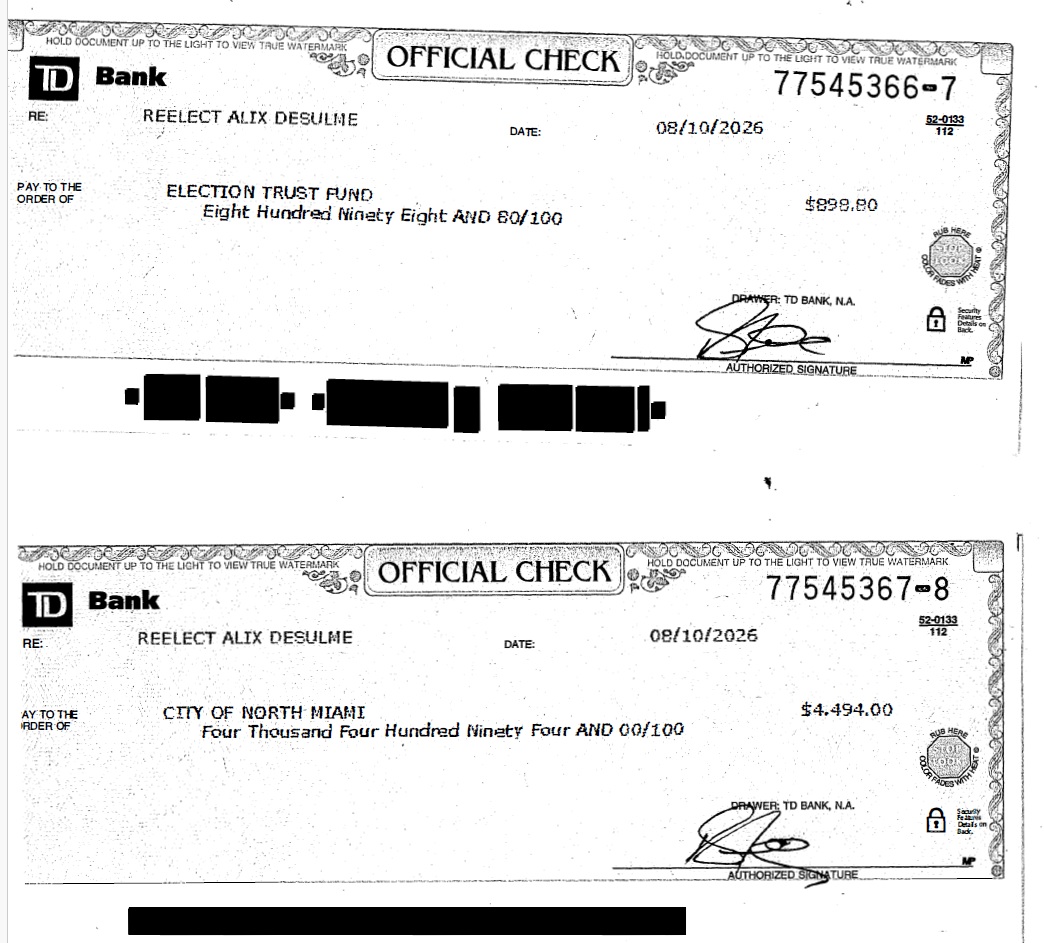
Desulme submitted two TD Bank Official Checks on August 10, 2026:
| Payment | Amount | Payable To |
|---|---|---|
| City qualifying fee | $4,494.00 | City of North Miami |
| 1% State mandated election assessment | $898.80 | Election Trust Fund |
These are two separate payments.
The $4,494 was North Miami’s qualifying fee. A candidate can get signatures in lieu of this fee. The $898.80 was the separate election assessment required by Florida Statute §99.093, equal to 1% of the annual salary of the office sought.
The City collects the 1% assessment, but Florida law requires it to be forwarded to the Florida Elections Commission for deposit into the Elections Commission Trust Fund.
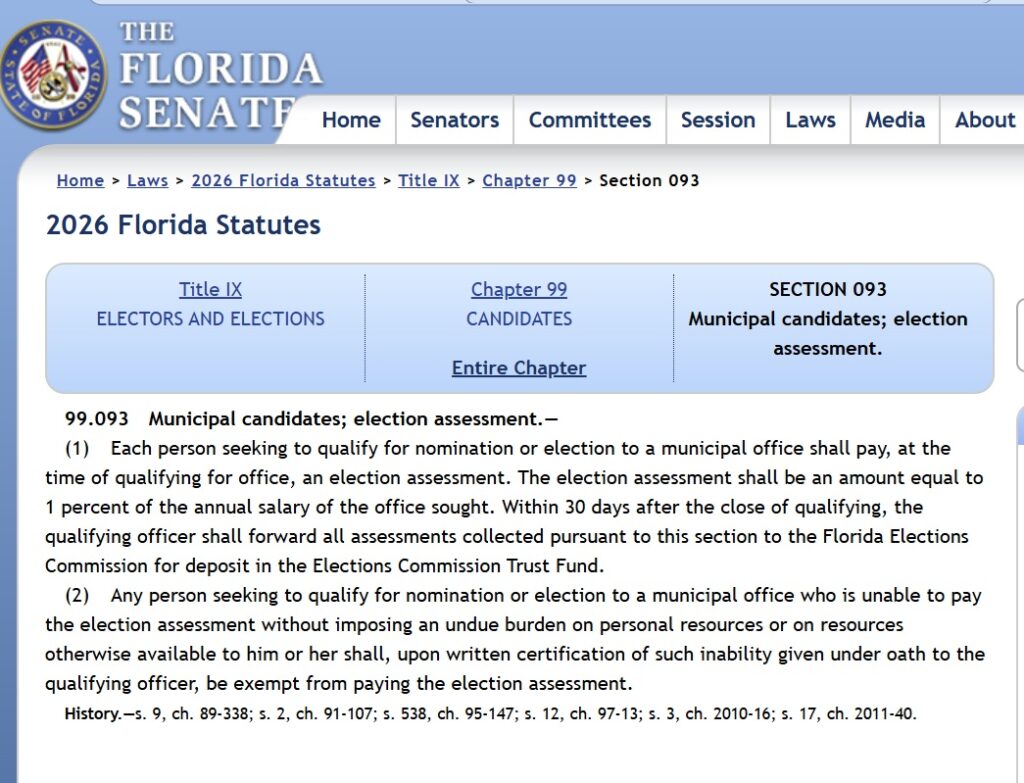
Florida Statute §99.093 — Municipal Election Assessment
Morgan’s complaint challenges both of Desulme’s checks.
What Is Morgan Challenging?
Morgan alleges that Desulme submitted TD Bank Official Checks issued by the bank, rather than checks drawn directly on his campaign account.
Morgan also challenges the signatures. Desulme’s campaign documents identify Emmanuella Fluerimont as his campaign treasurer, while the Official Checks bear a bank-authorized signature.
Morgan argues that these defects mean Desulme did not properly qualify.
Those are Morgan’s allegations. The court will determine whether the checks complied with the law and what effect, if any, they have on Desulme’s qualification.
What Does Florida Law Require?
For the City qualifying fee, Florida Statute §99.061(7)(a)1 requires a properly executed check drawn on the candidate’s campaign account. North Miami Code §6-21(d) similarly requires its qualifying fee to be paid by a check drawn on the candidate’s campaign account.
Florida law provides a specific procedure for using a cashier’s check when an original qualifying check has been returned by the bank. That is different from initially submitting a cashier’s check.
Florida Statute §99.061 — Candidate Qualifying Requirements
For the separate 1% municipal election assessment, Florida Division of Elections Advisory Opinion DE 13-04 directly addressed the payment method. The Division concluded that the assessment must be paid by check drawn on the candidate’s campaign account, unless an applicable special act, municipal charter provision or ordinance provides otherwise.
Florida Division of Elections Advisory Opinion DE 13-04
Florida Statute §106.11 also governs expenditures from campaign accounts and requires campaign checks to contain the signature of the campaign treasurer or deputy treasurer.
Florida Statute §106.11 — Campaign Account Expenditures
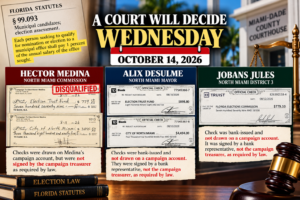
Hector Medina Was Already Disqualified Over His Checks
Florida law requires campaign checks to be drawn on the candidate’s campaign account and signed by the campaign treasurer or deputy treasurer. Florida Statute §106.11
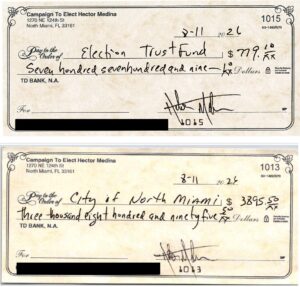
District 2 candidate Hector Medina satisfied the first requirement by submitting checks drawn on his campaign account. However, he signed them himself rather than having his designated campaign treasurer, Alina Medina, sign them. On September 3, 2026, Judge Christopher Green disqualified Medina.
Desulme and Jules submitted bank-issued checks bearing bank representatives’ signatures, rather than checks signed by their designated campaign treasurers. Morgan’s lawsuit challenges Desulme’s checks on these grounds, while Jules’ qualifying records raise the same questions concerning his 1% election assessment.
If Medina was disqualified because his checks lacked the required treasurer’s signature, why were bank-signed checks accepted from Desulme and Jules? What legal distinction, if any, justifies treating these candidates differently?
What About Jobans Jules?
District 3 candidate Jobans Jules qualified through the petition process, so he did not have to pay North Miami’s qualifying fee. However, qualifying by petition did not eliminate the separate 1% state election assessment. Jules’ qualifying records show that he submitted a $779.10 Truist Bank cashier’s check payable to the Election Trust Fund, signed by a bank representative.
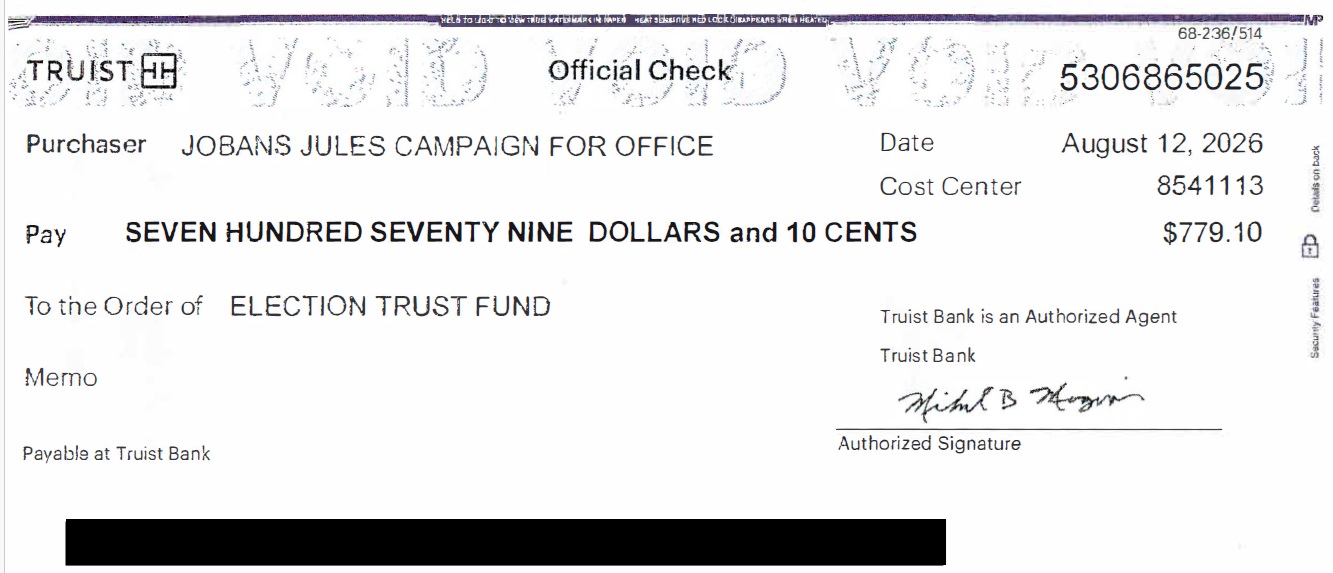
Compare the two 1% assessment payments:
| Alix Desulme | Jobans Jules | |
|---|---|---|
| 1% assessment | $898.80 | $779.10 |
| Payable to | Election Trust Fund | Election Trust Fund |
| Payment instrument | TD Bank Cashier’s Check | Truist Bank Cashier’s Check |
The amounts differ because Desulme and Jules sought offices with different salaries. Both payments, however, were for the same type of state-required 1% election assessment. Jules is not a party to Morgan’s lawsuit, and Morgan is not asking the court to determine whether Jules properly qualified. But because DE 13-04 specifically addresses the payment method for the 1% assessment, Jules’ qualifying records raise a separate question:
Did the cashier’s check he submitted satisfy the legal requirements for payment of the 1% assessment?
Read DE 13-04 — Florida Department of State (PDF)
Carolina Matamoros Used the Hardship Provision
Florida law also provides an alternative for a candidate who cannot pay the 1% election assessment without creating an undue financial burden. Under §99.093(2), a candidate may timely submit the required sworn certification seeking an exemption. District 3 candidate Carolina Matamoros used this procedure and submitted sworn hardship documents seeking the exemption.
Jobans Jules had the same statutory option. He did not have to pay the 1% assessment if he qualified for the hardship exemption and timely submitted the required paperwork. However, once Jules chose to pay the assessment rather than seek an exemption, the payment had to comply with the legal requirements governing that payment—including the requirement that it be drawn on the campaign account and the applicable campaign-treasurer signature requirement.
What Could Wednesday’s Hearing Mean?
Wednesday’s lawsuit concerns Alix Desulme, not Jobans Jules.
But one of the Desulme payments being challenged is his $898.80 payment to the Election Trust Fund. The court’s interpretation of the requirements governing that payment could therefore provide guidance about the rules applicable to the same 1% assessment paid by all other North Miami candidates.
The broader question is straightforward:
What did the law require, what did each candidate submit, and were those requirements applied consistently?