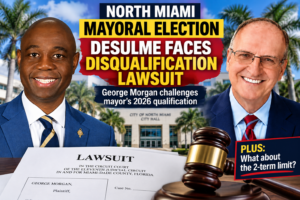

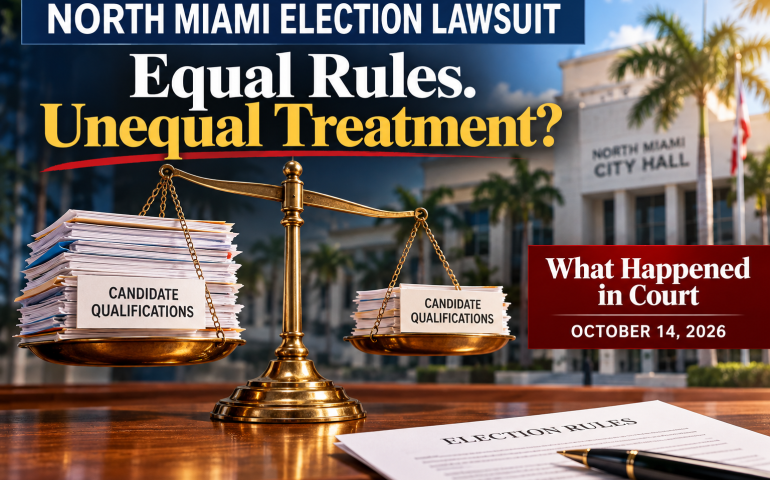
A hearing challenging North Miami Mayor Alix Desulme’s qualification for the November election raised questions about the validity of his cashier’s checks, his challenger’s own qualification, and the City’s responsibility to enforce election laws.
The hearing lasted approximately two hours. Attorneys representing Morgan, Desulme, the City of North Miami, and the Miami-Dade Supervisor of Elections presented their positions.
Judge Beatrice Butchko Sanchez questioned attorneys for both candidates and the City of North Miami, criticized the City’s handling of the qualifying process, and ordered additional evidence before deciding the case.
Desulme Challenges Service of Process
Desulme’s attorney, Benedict Kuehne, entered a limited appearance, preserving his objection to improper service and requesting more time to present evidence on due process grounds.
Morgan’s attorney noted that a return of service had been filed. Judge Butchko Sanchez explained that service is presumed valid and the burden of proving otherwise falls on the party challenging it.
The judge said the issue could be addressed in a separate evidentiary hearing with the process server. Even if service were defective, Desulme could be served again. She proceeded with the election-law arguments without ruling on service, while preserving Kuehne’s right to an evidentiary hearing.
Morgan Challenges Desulme’s Cashier’s Checks
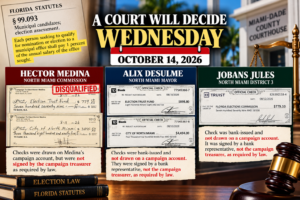
George Morgan’s attorney argued that Desulme failed to qualify legally because he submitted two TD Bank cashier’s checks signed by bank officials rather than his designated campaign treasurer.
Florida Statute § 99.061(7)(a)1 requires:
“A properly executed check drawn upon the candidate’s campaign account.”
North Miami Code § 6-21(d) states:
“Payment of the fee shall be by a check drawn on the candidate’s campaign account payable to the City of North Miami,”
Morgan sought Desulme’s disqualification, removal from the City’s qualified-candidate list, notification to the Miami-Dade Supervisor of Elections, and an injunction preventing the City from recognizing his qualification or certifying votes or results for him.
The attorneys discussed Thompson v. North Bay Village and Timothe v. Medina. In the latter case, Hector Medina was disqualified by the trial court because he personally signed a check drawn on his campaign account instead of having his campaign treasurer sign it. Morgan’s attorney initially described that ruling as affirmed on appeal, but the statement was corrected because the merits of the appeal remained pending.
Desulme’s Attorney Argues a Treasurer’s Signature Is Not Required
Kuehne argued that Florida Statute § 100.3605(1) allows municipal charters and ordinances to govern local elections where applicable, except when state election provisions expressly apply to municipalities.
He maintained that North Miami Code § 6-21(d), unlike Florida Statute § 99.061(7)(a)1, does not require a “properly executed” check or a campaign treasurer’s signature. He argued that Desulme’s cashier’s checks complied because they were purchased with campaign-account funds.
The judge questioned whether a cashier’s check purchased with funds from a campaign account qualifies as a check drawn on that account.
The discussion included Thompson v. North Bay Village and whether North Miami’s ordinance controls the qualifying requirements.
Morgan’s attorney argued that compliance must be established by the documents submitted before the qualifying deadline, not evidence produced afterward.
Morgan’s Own Qualification Is Challenged
Kuehne alleged that Morgan underpaid the required 1% election assessment by 80 cents.
He also questioned whether Morgan’s check, bearing the account name “Committee to Elect George Morgan for Mayor 2026,” came from the campaign depository designated on his DS-DE 9 form.
Morgan’s attorney explained that Morgan identified it as the same campaign account and that the bank used the name appearing in the campaign’s IRS Employer Identification Number documentation. The City also raised questions about Morgan’s qualification.
The judge indicated that the account name alone did not resolve the issue and requested supporting records.
During the exchange, she quoted a Spanish proverb:
“No tires piedras si tu tejado es de cristal.”
“Don’t throw stones if your roof is made of glass.”
Morgan’s attorney also described a vehicle crashing through a window and wall of North Miami City Hall while Morgan was writing his qualifying check. The judge asked specifically whether he was writing the check at the time. Counsel said witnesses were available to explain the disruption, after which Morgan was instructed to continue completing his check.
No ruling was made concerning the alleged underpayment.
Desulme’s Attorney Challenges Morgan’s Standing and the Timing of His Lawsuit
Kuehne challenged Morgan’s standing to sue, arguing that Morgan’s own alleged qualifying deficiencies could affect his eligibility to challenge Desulme. The Plaintiff’s lawyer questioned whether that issue could be decided without a separate legal claim.
Kuehne also challenged the timing of the lawsuit, approximately 49 days after the August qualifying period. Morgan’s attorney said the issue was discovered October 2 while reviewing qualifying records on the City’s website.
The judge questioned why the records had not been reviewed earlier. The attorneys discussed laches, including whether the delay prejudiced the election process after voting had begun.
No ruling was issued on standing or the delay.
Judge Criticizes North Miami’s Qualifying Process
The City’s attorney acknowledged that the City Clerk had not identified either Desulme’s potentially deficient cashier’s checks or Morgan’s alleged 80-cent underpayment during qualification. The City described its role as ministerial, citing Florida Statute § 99.061(7), including provisions governing qualifying officers and notification of deficiencies.
The judge contrasted North Miami’s process with the state’s, observing: “Tallahassee’s really good about letting you know if you’ve made a mistake.” She questioned why the City had not notified the candidates while they still had time to correct deficiencies, stating: “If the city had taken more care, we wouldn’t be here.”
In Timothe v. Medina, Medina argued that he submitted his qualifying paperwork nine days before the deadline, leaving ample time for the City to notify him of the improper signature so he could correct it.
The City raised concerns about disenfranchising voters, noting that approximately 1,363 vote-by-mail ballots had already been returned.
The judge challenged that argument:
“Your speech talking about the right to fair and free elections and not to disenfranchise anyone really begins at home.”
She also questioned the potential for selective enforcement of qualifying requirements, asking:
“You see where that is a problem?”
She emphasized:
“You’re the government. And I think the government has to be an advocate for the rules being followed.”
At another point, the judge stated:
“Two wrongs don’t make a right.”
The court made no finding of intentional favoritism.
Judge Demands the City’s Interpretation of Its Ordinance
The judge pressed North Miami’s attorney to explain whether § 6-21(d) requires only a check drawn on the campaign account or also incorporates Florida’s properly executed check requirement.
When the City’s attorney expressed reluctance to take sides, the judge responded:
“You’ve already done that. You’ve already taken a side. But the point here is you’re the city. This is the city’s code of ordinances. I don’t want to step on the city’s toes. You’re the city attorney, so you have to, I think, tell me what this says.”
The judge said she did not want to rewrite the City’s ordinance from the bench.
She ordered the City to submit its interpretation by Thursday, October 15, or state in writing that it declined to take a position.
Judge Requests Bank Evidence and Additional Briefing
Kuehne maintained that Desulme’s cashier’s checks were purchased using campaign funds. The judge requested campaign treasurer reports and a bank affidavit confirming the source of the money by October 15.
The judge also requested further submissions addressing the relationship between state and municipal election law, Morgan’s standing and qualification, the 80-cent discrepancy, the designated campaign account, the timing of the lawsuit, and relevant case law, including Thompson.
Supervisor of Elections Addresses Possible Outcomes
The Miami-Dade County Supervisor of Elections’ attorney explained how the County could implement a court ruling disqualifying Desulme, even though vote-by-mail ballots had already been distributed.
The attorney also brought up a separate pending lawsuit filed by Lixon Nelson, another prospective mayoral candidate. In Lixon Nelson v. Vanessa Joseph, et al., Case No. 26-019266-CA-01, Nelson is seeking access to the mayoral ballot after being informed that he would not qualify.
The County’s attorney explained that Nelson’s name had never been included on the list of qualified candidates submitted to the Supervisor of Elections. Even if Nelson prevailed in his lawsuit, adding him to ballots already distributed to voters was no longer a practical option.
By contrast, the attorney explained that if Morgan prevailed and Desulme were disqualified, the County could implement the court’s ruling without reprinting ballots. Under that scenario, Morgan could potentially be deemed elected as the remaining qualified candidate.
The Supervisor of Elections took no position on whether Morgan or Desulme had properly qualified and stated that the County would comply with the court’s orders.
No Ruling; Hearing to Continue October 19
Judge Beatrice Butchko Sanchez did not issue a ruling during the October 14 hearing. She took the matter under advisement and requested additional evidence and legal briefing.
According to the court’s hearing schedule, proceedings will continue Monday, October 19, 2026, at 11:30 a.m., at the Osvaldo N. Soto Miami-Dade Justice Center, Courtroom 21D.