
Summary: What the Judge Decided
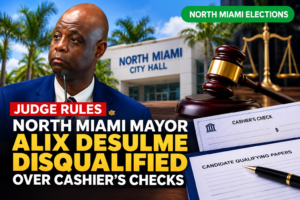
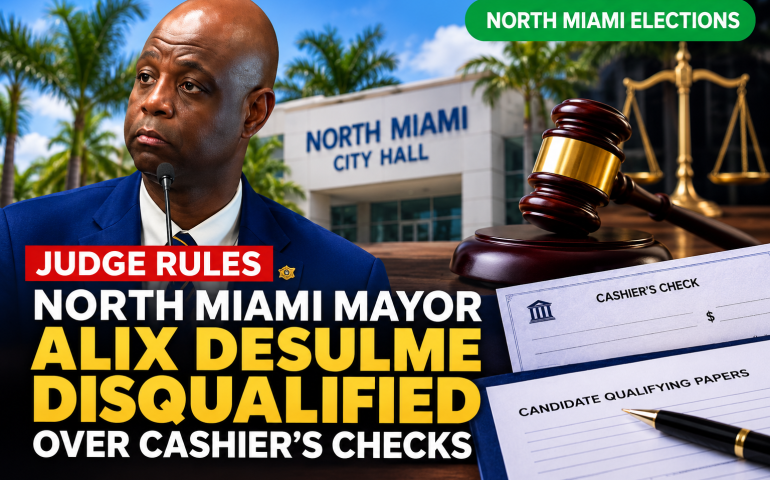
On October 19, 2026, the first day of early voting, Miami-Dade Circuit Judge Beatrice Butchko ruled that North Miami Mayor Alix Desulme failed to meet the legal requirements to qualify for reelection on November 3.
In George E. Duell Morgan v. City of North Miami, et al., Case No. 2026-020505-CA-01, the judge found that Desulme’s two TD Bank official checks, although purchased with money from his campaign account, were not themselves drawn on that account as required by Florida law and North Miami’s ordinances.
A key issue was North Miami’s earlier legal position in the Hector Medina case. The City had argued that Florida’s properly executed check requirement applied to municipal elections when local ordinances did not establish a different rule. Yet in Desulme’s case, the City declined to take a position on whether the mayor’s checks satisfied that requirement.
The judge also rejected an argument that Morgan’s own alleged qualifying deficiency barred his lawsuit. Following a separate hearing on service of process, she determined that Desulme had been properly served.
Judge Butchko ruled that Desulme “shall be disqualified as a candidate for mayor” and directed Morgan’s attorney to prepare the written ruling.
What Happened in Court
The following account details the testimony, disputed facts, legal arguments, statutory requirements, and judicial reasoning behind the October 19 decision.
The Dispute Over Service of Process
Before addressing Desulme’s qualifications, Judge Butchko considered whether he had been properly served with the lawsuit.
Desulme’s attorney, Benedict P. Kuehne, challenged the process server’s sworn report that documents had been delivered to a man identified as “Michael Doe” at Desulme’s home on October 12.
According to the report, the man acknowledged that Desulme lived there but was not home. When asked whether he himself lived at the property, the man reportedly answered yes. He nevertheless objected to accepting the documents and asked the process server to return when Desulme was home. The process server described him as a Black male, approximately 30 years old, 5 feet 9 inches tall, and weighing 175 pounds.
Desulme testified that he was in Ghana on October 12, lived alone, and that nobody named Michael resided at his home. During cross-examination by Morgan’s attorney, Sasha Bardelas, Desulme acknowledged that Prince Sam, the son of a friend, had electronic access to his home and had been collecting mail while he was away. Sam could enter using an application without Desulme being present. Desulme described Sam as a Black male in his twenties, approximately 5 feet 9 inches tall and weighing 150 to 160 pounds—a description resembling parts of the process server’s account.
Although Desulme maintained that Sam did not live there or have permission to stay, he acknowledged that he did not know whether Sam had stayed at the property or was present when the process server arrived. Asked whether Sam had stayed there, Desulme replied, “I have no idea.”
The process server also reported two vehicles with personalized license plates bearing variations of Desulme’s name. Desulme explained that one belonged to his nephew, who had left it at the property while traveling in Europe.
Desulme’s account of when he returned from Ghana also changed. He initially said Saturday, corrected himself to Thursday, October 15, and later confirmed Friday, October 16, after checking his calendar.
Bardelas questioned when Desulme learned of the lawsuit, noting that Kuehne’s October 14 filing indicated counsel had learned of the hearing on October 13. Asked whether he was aware of the proceedings by then, Desulme acknowledged, “I’ve heard from the city, yes.”
Another discrepancy concerned the service documents. Desulme initially indicated that, to his knowledge, no papers had been left at his home. However, when questioned further by his own attorney, he acknowledged finding them outside his front door upon returning.
“Yes, in front of my door. There was the papers,” he testified.
The attorneys also disputed whether North Miami City Hall had been open on Columbus Day, October 12. Morgan’s legal team believed it was closed, which was part of the explanation for attempting service at the residence. Kuehne said he had learned from the clerk that it was open, while Morgan’s side questioned that information. Desulme acknowledged that he had assumed City Hall was closed.
After reviewing the testimony and the process server’s sworn report, Judge Butchko requested testimony from the process server before deciding whether service was valid.
Because he was unavailable that morning, the court proceeded with arguments concerning Desulme’s qualifications.
Later that day, the court held a separate evidentiary hearing. The process server testified remotely via Zoom, and Judge Butchko determined that Desulme had been properly served with the lawsuit.
That resolved the procedural challenge to the court’s ruling on Desulme’s qualifications.
North Miami’s Earlier Legal Position Comes Under Scrutiny
With the service question temporarily set aside, the hearing turned to whether Desulme’s two TD Bank official checks satisfied the applicable election laws.
The answer required examining not only Florida election law and North Miami’s ordinances, but also a position the City had taken in another recent election lawsuit.
At the October 14 hearing, Judge Butchko expressly stated that she did not want to legislate from the bench. She therefore asked the City’s attorney to explain how North Miami interpreted its own election laws governing the qualifying-check requirements at the center of the dispute.
The City’s attorney expressed concern that providing such an interpretation could amount to taking sides in the lawsuit.
“You’ve already done that. You’ve already taken a side,” Judge Butchko responded.
The judge then ordered the City to file its interpretation of the applicable laws by the following day or formally decline to provide one.
On October 15, North Miami filed a supplemental statement declining to say whether Desulme’s cashier’s checks were acceptable. The City maintained that its administrative responsibility for determining candidate qualifications had ended and emphasized protecting the rights of voters and candidates during an election already underway.
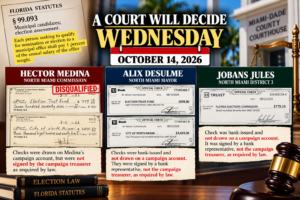
But the filing also disclosed the City’s position in the separate Hector Medina litigation. Medina had been disqualified after personally signing his qualifying check rather than having it signed by his designated campaign treasurer or deputy treasurer.
In its appellate brief in that case, North Miami argued:
“The Properly Executed Check Requirement mandatorily applies to the conduct of a municipality’s election”
The City qualified that position by referring to the absence of an applicable special act, charter, or ordinance provision establishing a different requirement.
In other words, North Miami had argued that Florida’s properly executed check requirement applied to its municipal elections when the City’s ordinances did not provide a different rule.
At the October 19 hearing, Judge Butchko specifically directed attention to page three of the City’s October 15 filing, where its earlier legal position was disclosed. Although Medina involved different facts, she described the City’s position as informative.
City attorney Richard Rosengarten explained that North Miami did not want to withhold its earlier argument, even while declining to take a position on Desulme’s qualification.
The contrast was significant. The City had argued for applying the state requirement in Medina but declined to say whether the Desulme’s cashier checks satisfied that requirement.
Oren Rosenthal, representing the Miami-Dade County Supervisor of Elections, also addressed the court. He urged consistent judicial guidance, or an explanation when rulings differed, because election officials were responsible for carrying out those decisions.
Judge Butchko acknowledged his concern.
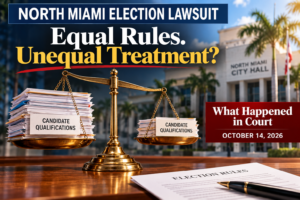
The cases involved different types of checks, but raised a common legal question: When North Miami’s election rules do not specifically address a requirement, does Florida election law apply?
Morgan’s Attorney Challenges the Qualifying Checks
Morgan’s attorney, Sasha Bardelas, argued that Desulme’s two TD Bank official checks failed to meet the requirements for qualifying as a mayoral candidate.
The dispute concerned both which account the checks were drawn on and who signed them.
Four provisions of Florida and North Miami election law were central to the argument.
Florida Statute §99.061(7)(a)1 requires:
A properly executed check drawn upon the candidate’s campaign account payable to the person or entity as prescribed by the filing officer.
The statute also permits a cashier’s check in a specific circumstance: when an original qualifying check is returned by the bank and a replacement purchased with campaign funds is submitted before qualifying closes.
Florida Statute §106.11(1)(b)4 requires a campaign check to contain:
The signature of the campaign treasurer or deputy treasurer.
North Miami Code §6-21(d) requires:
Payment of the fee shall be by a check drawn on the candidate’s campaign account payable to the City of North Miami.
The City’s ordinance specifies the account from which payment must be drawn but does not expressly identify who must sign the check.
However, North Miami Code §6-4, “Matters not specifically covered,” provides:
In all matters pertaining to elections in the city where the same are not specifically provided for by this or any other ordinance, the laws of the state providing the rules, regulations and methods for holding elections and ascertaining the results thereof shall govern.
Bardelas argued that Desulme’s checks presented two problems: they were drawn on TD Bank’s account rather than directly on the campaign account, and they were signed by a bank representative rather than the campaign treasurer or deputy treasurer.
She compared the dispute with Medina’s disqualification. Medina had submitted a campaign check bearing his own signature; Desulme had submitted bank-issued official checks. Although the facts differed, both cases raised questions about what constitutes a properly executed qualifying check.
Bardelas maintained that evidence showing Desulme’s campaign treasurer authorized the withdrawal of campaign funds did not establish that the bank-issued checks themselves complied with the law. She cited Florida appellate decisions concerning mandatory candidate-qualification requirements, including Boatman v. Hardee and Thompson v. North Bay Village. Bardelas also brought a recent Broward County ruling to the court’s attention. In Gelin v. City of Tamarac, Judge Michael Robinson had disqualified incumbent Commissioner Morey Wright Jr. on October 14 over deficiencies involving his campaign treasurer designation and other qualifying documents.
She informed Judge Butchko that Wright had appealed and requested a stay which was being heard the same day and this hearing.
Bardelas’s central argument was that the qualifying checks themselves had to satisfy the legal requirements, regardless of whether the money originated from campaign funds or election officials had initially accepted the payments.
Desulme’s Defense and the Challenge to Morgan’s Qualification
Desulme’s attorney, Benedict Kuehne, argued that the two TD Bank official checks complied with the qualifying requirements because they were purchased using money withdrawn directly from Desulme’s campaign account. He presented banking records and withdrawal authorizations involving campaign treasurer Emmanuella Fleurimont to establish the source of the funds and the treasurer’s involvement.
Judge Butchko pressed Kuehne on a central distinction: The money originated in the campaign account, but were the checks themselves drawn on that account?
Kuehne sought to distinguish an official check from a cashier’s check and emphasized the difference between the statutory phrase “drawn upon” and the City’s wording “drawn on.” The judge questioned how those distinctions affected the legal requirements.
Kuehne also argued that the treasurer had “caused to be issued” the checks by authorizing the withdrawal of campaign funds. Judge Butchko questioned the source of that language and whether authorizing the transactions satisfied the requirements governing the checks themselves.
Bardelas questioned why the campaign treasurer had not simply written checks directly from the campaign account. She pointed out that anyone attempting to trace the source of the payments would need to obtain additional banking records to establish that the funds originated from Desulme’s campaign account.
Her argument highlighted the importance of transparency and traceability in campaign finance laws, which establish requirements for documenting political contributions and expenditures.
The disagreement was whether the treasurer’s authorization and the source of the money were sufficient, or whether the bank-issued checks themselves had to comply with the qualifying requirements.
Kuehne also challenged Morgan’s own qualification.
He alleged that Morgan paid $898.00 toward a required election assessment of $898.80, leaving an 80-cent shortfall.
Morgan received notice of the shortfall on October 14, the day of the earlier court hearing, and reportedly paid the additional 80 cents within 48 hours of notification.
Bardelas argued that Florida law permits a candidate to correct a qualifying payment deficiency within 48 hours after notification. She maintained that Morgan had paid within that period and remained qualified.
Kuehne invoked the doctrine of unclean hands, arguing that Morgan’s own alleged qualifying deficiency should prevent him from challenging Desulme.
Judge Butchko later rejected that argument. She noted that Morgan remained a qualified mayoral candidate unless and until declared otherwise, and found no evidence that he had engaged in “fraud, deceit, or trickery” in bringing the lawsuit.
The judge did not decide whether Morgan’s original underpayment or subsequent correction satisfied the applicable qualifying requirements.
The Judge’s Reasoning and Final Ruling
In announcing her decision, Judge Butchko began with North Miami Code §6-4, which directs that state election law governs matters not specifically covered by City ordinances.
She then examined §6-21(d), requiring a qualifying check drawn on the candidate’s campaign account and payable to the City.
Judge Butchko described North Miami’s qualifying-fee ordinance, §6-21(d), as “vague,” explaining that it did not specify whether cashier’s checks were permitted or who was required to sign a qualifying check.
Because the City’s ordinance did not expressly address those requirements, and North Miami Code §6-4 directs that state law governs matters not specifically covered by local ordinances, the judge concluded that Florida’s election statutes applied.
She identified Florida Statute §99.061(7)(a)1, requiring a properly executed check drawn upon the candidate’s campaign account, as a governing provision.
Judge Butchko then returned to the Medina litigation and North Miami’s earlier appellate argument that Florida’s properly executed check requirement applied to municipal elections when no local rule established a different requirement.
She also noted that both opposing candidates in Medina had argued that §99.061(7)(a)1 applied to North Miami’s municipal elections.
Although Medina involved a candidate who personally signed his campaign check, while Desulme used bank-issued checks, the judge distinguished the facts from the governing legal requirement.
“Although the facts in Medina were different from our facts here, the law applies just the same,” Judge Butchko stated.
This was a pivotal point: the City’s earlier argument became part of the court’s reasoning in the challenge to Desulme’s qualifications.
The judge next explained why the two TD Bank official checks failed to meet the requirements.
A cashier’s check, she explained, is drawn on the issuing bank, which pays the instrument from its own account. Although Desulme’s campaign funds were used to purchase the checks, the checks themselves were not drawn on his campaign account.
That distinction meant the payments did not satisfy Florida Statute §99.061(7)(a)1 or North Miami Code §6-21(d).
Judge Butchko also addressed substantial compliance, the legal doctrine under which some procedural deficiencies may be excused when the essential requirements have been met.
Citing Florida case law, she explained that substantial compliance does not excuse failure to meet mandatory candidate-qualification requirements. She referred to the qualifying-fee requirement as a bright-line rule.
The fact that Desulme’s campaign funds were used to purchase the checks therefore did not make the bank-issued instruments legally equivalent to checks drawn directly on his campaign account.
The judge also considered whether Morgan had waited too long to bring the lawsuit.
She found that he filed six days after his claimed discovery of the irregularity in Desulme’s qualifying documents and concluded that the action was timely.
She rejected the defense’s unclean-hands argument, finding no evidence of fraud, deceit, or trickery by Morgan, and reiterated that he remained a qualified candidate unless declared otherwise.
After reviewing the statutes, ordinances, case law, and arguments, Judge Butchko concluded that Desulme had failed to satisfy Florida Statute §99.061(7)(a)1 and North Miami Code §6-21(d).
She ruled that Mayor Alix Desulme “shall be disqualified as a candidate for mayor.”
At the time she announced that decision, the service-of-process challenge remained unresolved, and the judge expressly made the ruling subject to resolution of that issue. As described earlier, she subsequently found service valid after hearing from the process server at a separate hearing.
She instructed Morgan’s attorney, Sasha Bardelas, to prepare the written ruling, citing the case law she had outlined.
The Larger Question for North Miami
The October 19 proceedings brought renewed attention to how North Miami interprets and applies its election laws.
In the Medina litigation, the City had argued that Florida’s properly executed check requirement applied to municipal elections when no local ordinance established a different rule.
In the Desulme case, the City declined to take a position on whether the mayor’s checks satisfied the qualifying requirements, while acknowledging its earlier argument.
Judge Butchko examined that previous position alongside the governing statutes and municipal ordinances before reaching her decision.
The cases involved different facts, but both raised the question of whether Florida’s candidate-qualification requirements applied to North Miami elections.
For North Miami voters, the question is not simply whether a particular candidate should remain on the ballot.
It is whether the same election laws are interpreted and enforced consistently, regardless of the candidate involved.
About Our Reporting
North Miami Speaks is committed to factual reporting, examining public records, identifying discrepancies, and questioning inconsistencies in government decisions and enforcement of the law.
We distinguish factual reporting from editorial commentary. Our news coverage presents documented evidence, competing arguments, and official findings, allowing readers to draw their own conclusions. Our editorials provide a separate space for analysis, opinions, and recommendations.
Sources: Court proceedings and publicly filed documents in George E. Duell Morgan v. City of North Miami, et al., Case No. 2026-020505-CA-01, Eleventh Judicial Circuit, Miami-Dade County, Florida