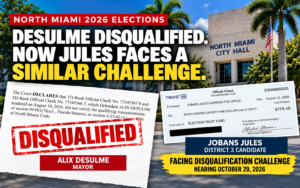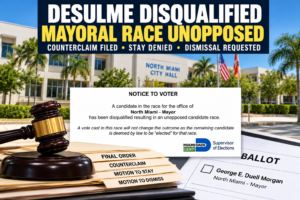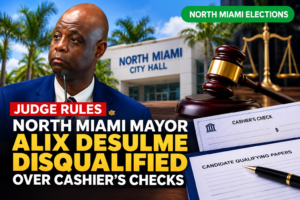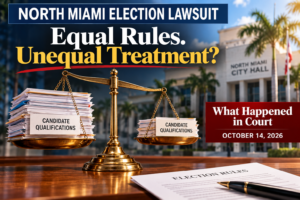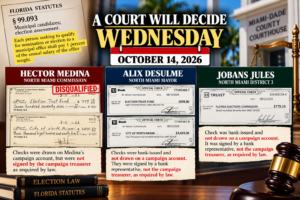
Miami-Dade Circuit Judge Beatrice Butchko Sanchez dismissed North Miami Mayor Alix Desulme’s counterclaim seeking to disqualify George Morgan over an alleged 80-cent shortfall in his qualifying fee. The ruling leaves Morgan as the only qualified mayoral candidate, three days after Desulme’s disqualification.
But following the decision, Desulme’s attorney made a public appeal for democracy that raises an uncomfortable question about North Miami’s past.
“You have to let us have an election, a real election where people can decide. This is America after all.”
Where was that concern in 2022?
Why the Judge Dismissed the Counterclaim
At the October 22 hearing, Desulme’s attorney, Benedict Kuehne, argued that the counterclaim was timely because the October 19 order disqualifying his client had not fully resolved Morgan’s lawsuit.
Morgan had requested both declaratory and injunctive relief. Kuehne maintained that because the judge had not made the specific findings required for an injunction, the case remained open.
Judge Butchko Sanchez disagreed.
She reviewed the relief requested in both counts and explained that her October 19 decision had resolved the underlying dispute. She had declared Desulme unqualified and directed that voters receive the appropriate notice.
The judge also corrected Kuehne’s characterization of the written order. She explained that she had recessed, prepared handwritten findings, announced her decision in court, and instructed Morgan’s attorney, Sasha Bardelas, to prepare an order reflecting those findings. She had not simply adopted a decision written by the plaintiff.
The court also questioned why Desulme had waited to challenge Morgan’s qualifications. His attorneys had contested service of process, but the judge noted that Desulme could have filed a separate lawsuit and sought consolidation with the existing case.
Kuehne maintained that Morgan’s alleged deficiency had already been raised in the defense’s filings and that the counterclaim was submitted promptly after the service issue was resolved. Bardelas argued that the defense had another legal avenue available but chose not to pursue it.
Ultimately, Judge Butchko Sanchez dismissed the counterclaim on three grounds: Desulme lacked standing after his disqualification, the counterclaim was filed after the original case had concluded, and the court lacked authority to order the December 1 special election he requested.
The judge did not determine whether Morgan’s alleged 80-cent shortfall violated election law. That question was never decided on its merits.
“This Is America After All”
Following the ruling, Desulme’s attorney told Channel 10 that voters should be allowed to choose their mayor rather than have the office effectively decided without a contested election.
His argument deserves attention—not because the principle is wrong, but because North Miami residents have heard that same argument before.
Watch the Channel 10 report:
https://www.youtube.com/watch?v=Ow4UjICEINc
Where Was This Concern for Democracy in 2022?
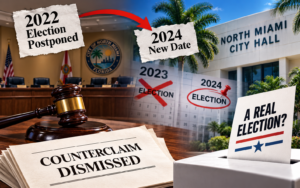
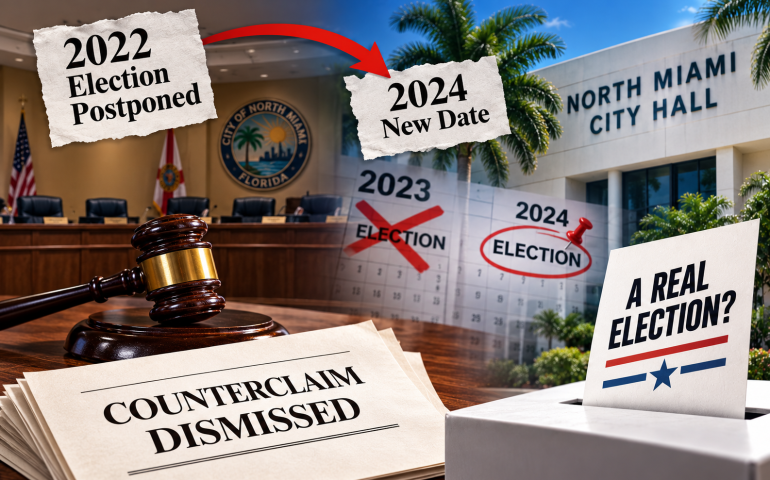
In 2022, following Mayor Philippe Bien-Aime’s resignation, the North Miami City Council repeatedly postponed action on a special election.
The Council ultimately appointed then-Councilmember Alix Desulme as mayor on December 13, 2022. At that same meeting, it moved the May 2023 municipal election to November 2024, extending incumbents’ terms by approximately 18 months.
The result? Desulme served approximately two years as mayor without being elected to that office by voters. He then won the November 2024 election for another two-year term.
North Miami voters adopted term limits restricting the mayor to two consecutive two-year terms. Yet Desulme sought another term in 2026.
In my view, allowing elected officials to extend their own terms and then exclude that additional time from the purpose of voter-approved term limits defeats the will of the electorate.
The 2025 City of Miami election litigation raised the broader legal issue of whether municipalities in Miami-Dade County may change election dates and extend officials’ terms without voter approval under the County’s Home Rule framework. Although North Miami’s 2022 action has not been invalidated by a court, it deserves examination under the same principles.
Residents can review the North Miami City Council meetings of November 7, 18, and 21, and December 13, 2022, and judge the decisions for themselves.
The Council justified postponing the 2023 election as a cost-saving measure. Yet it also approved $20,000 annually in advertising funds for each of its five members—a combined $100,000 per year.
If saving taxpayers’ money justified postponing an election and extending elected officials’ terms, how did the Council justify spending $100,000 annually on its own advertising?
In 2025, the City of Miami attempted something similar: postponing its municipal election and extending incumbents’ terms without voter approval. The Third District Court of Appeal affirmed a ruling that the ordinance was unconstitutional under Miami-Dade County’s Home Rule framework.
The decision in City of Miami v. Gonzalez raises a serious question about North Miami’s 2022 election postponement. Both municipalities are subject to Miami-Dade’s Home Rule provisions. If Miami could not extend officials’ terms without voter approval, what legally distinguished North Miami’s decision to do so three years earlier?
Democracy Cannot Be Selective
I agree with Desulme’s attorney that voters should have a meaningful opportunity to choose their elected officials. But that principle cannot suddenly become important only when an election outcome threatens an incumbent’s position. It mattered in 2022, when the Council postponed an election and extended its own terms. It matters today when candidates challenge one another’s qualifications. And it matters whenever election laws and term limits are enforced.
The right to vote belongs to the people of North Miami, not to whichever politician stands to benefit from the rules at a particular moment.
If we demand respect for democracy in 2026, we must be willing to demand the same accountability for what happened in 2022.